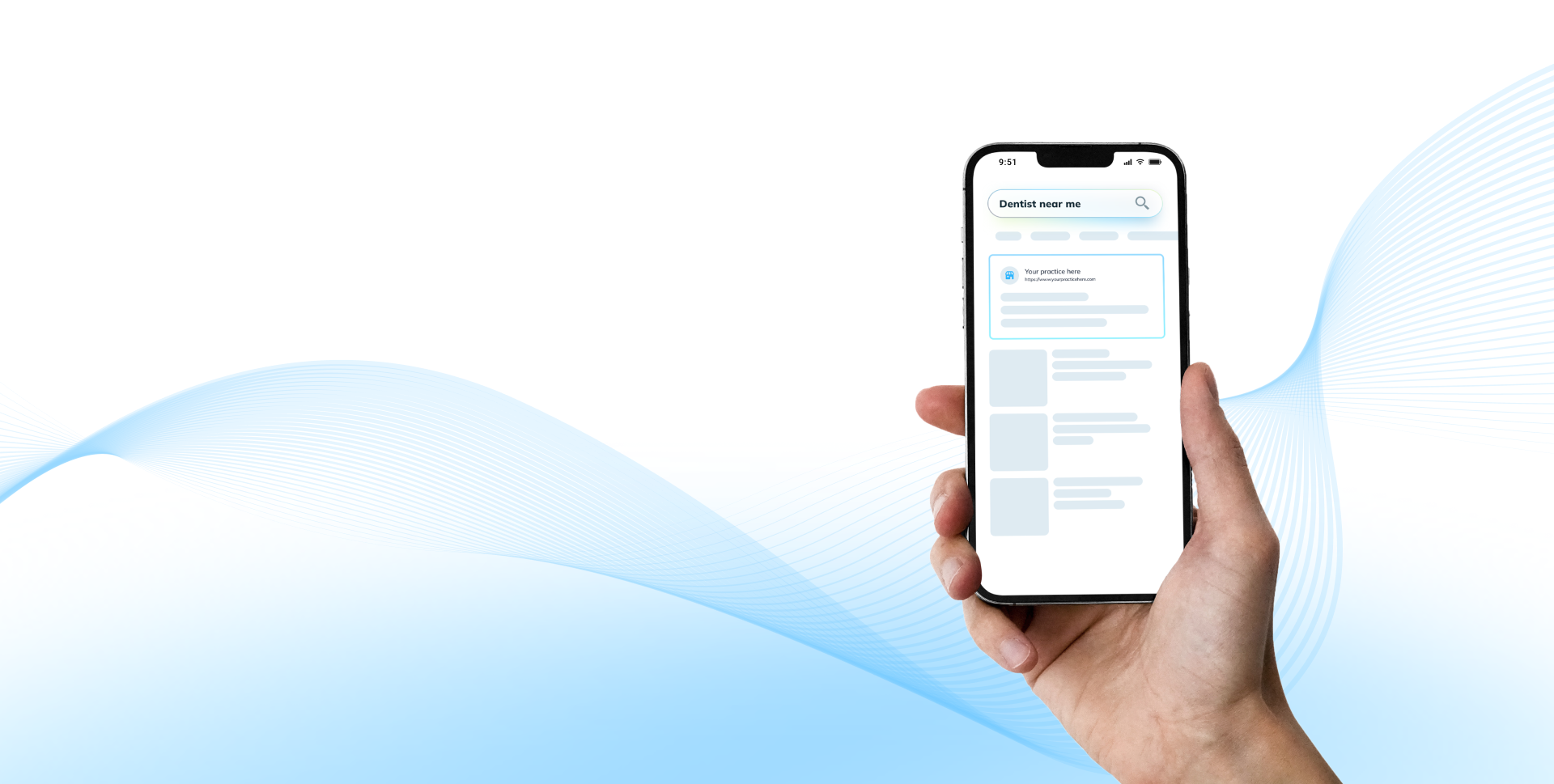
For the last two years, the story about AI search has been mostly one of loss. Google started answering questions directly at the top of the results page, and dental practices watched and worried that patients would get their answer from an AI summary and never click through to a website at all. That fear was reasonable. But the picture just shifted, and the shift is good news for practices that have done the right groundwork.
On October 15, 2026, Google announced that its AI answers, both AI Overviews (the summary that appears at the top of a normal search) and AI Mode (the full conversational search experience), will now show more links, place them higher in the response, and, in a new test, surface a dedicated section of official websites at the very top of certain answers. In plain terms: Google's AI is linking out more, and there is a fresh opportunity for your practice to be one of the links a patient actually taps. Here is what changed, what is confirmed versus still being tested, and the practical work that puts your practice in a position to be chosen.
What actually changed
Google's announcement, written by product management VP Hema Budaraju, laid out several related changes. The two that matter most for a local dental practice are these:
- Inline links are moving higher and appearing more often. An inline link is a link built into a word or phrase inside the AI's answer, rather than tucked away at the bottom. Google says it will now place these links higher up in responses more frequently, so a cited source is clickable right where the reader is looking.
- A dedicated official websites section is being tested. When there are only one or two official places on the web that can answer a question or complete a task, Google is testing a section at the top of the AI response that surfaces those official links, with a short note about why each one is useful.
The announcement also mentioned richer news carousels and clickable creator profiles on video results. Those matter more for publishers and video creators than for a typical practice, so we will set them aside.
Two points of precision. First, the official websites section is explicitly described by Google as a test, not a finished, everywhere feature, so treat it as a direction of travel rather than a guarantee. Second, this is about how links are displayed, not a new ranking system. Google's own documentation on AI features is blunt about this: there are no additional requirements to appear in AI Overviews or AI Mode, nor other special optimizations necessary, and there is no special schema you must add. The fundamentals that earn you a spot are the same fundamentals that have always mattered.
Why this matters for dental practices
A patient searching 'do I need a crown or a filling,' 'how much does Invisalign cost near me,' or 'is a dentist open on Saturday in [town]' increasingly sees an AI answer first. Until now, that answer often ended the journey. With links moving higher and an official-websites section in testing, the AI answer can become the start of the journey again, if your practice is the source it reaches for.
- AI search visibility with a click attached: being mentioned in an AI answer is nice, but being the mentioned source the patient can tap, placed high in the response, is what actually fills a chair. The update tilts toward the clickable version.
- A real edge for the official source: for a question like 'book a new-patient appointment at [your practice]' or 'what are [your practice]'s hours,' you are the official source, and the official-websites test is designed for exactly that one-or-two-answer situation.
- Local competition on clarity, not keywords: the practice whose website answers the real question plainly, and whose profile and reviews tell the same story, gives the AI clean material to cite.
- Patient trust: when a nervous patient sees your own website cited and linked beside an AI answer, that is a credibility signal before they ever reach your homepage.
The honest caveat: you still can't fully measure it
One frustration is worth naming so you plan around it. Even with more links showing, Google Search Console still does not break out click data for individual AI links. As Search Engine Journal pointed out when the update landed, Search Console assigns every link inside an AI Overview the overview's single position, so moving an inline link higher in the response does not, by itself, change what Console reports. You will likely see AI-driven visits inside your normal Web performance data, but you cannot yet isolate how many patients clicked you from an AI answer with precision.
The takeaway is not to ignore AI search; it is to avoid chasing a number you cannot cleanly see. Judge your progress by the things you can measure, new-patient calls and booked appointments, and by whether your practice actually shows up and gets linked when you test real patient questions yourself.
What your practice should do
You cannot make Google link to you. You can make your practice the obvious, clean, trustworthy source to link to. Start with the quick checks this week, then build the durable work over the next month or two.
- 1Test the real questions yourself. Search the things your patients search, 'dentist open Saturday [town],' '[your practice] new patients,' 'cost of Invisalign [town],' in both a normal search and AI Mode. Note where the AI pulls its answer and whether your site is linked. That is your punch list.
- 2Make your website answer the question first. For each common question, have a page or clear section that leads with the plain answer, then explains. New-patient information, emergency care, insurance and financing, specific services, and a genuine FAQ are the highest-value pages.
- 3Keep your core facts identical everywhere. Your name, address, phone, hours, and services should match on your website, your Google Business Profile, and the major directories. Conflicting information gives the AI a reason to hedge or to trust a competitor.
- 4Use structured data so machines read you reliably. LocalBusiness or the more specific Dentist type, plus FAQPage markup, help Google parse your hours, location, and answers. Google says you do not need special schema to appear, but accurate markup removes ambiguity about the facts that matter to a patient.
- 5Strengthen the signals behind the answer. Real doctor bios with credentials, consistent service pages, and reviews that mention specific treatments all give the AI substance to cite, rather than a bare star rating.
- 6Re-test quarterly. AI answers drift as your reviews, your site, and the wider web change, so make the self-test a standing quarterly habit for whoever owns your marketing.
How DentalQore thinks about this
DentalQore has built dental websites around a simple idea for a while now: be the answer AI actually gives, not a link buried beneath one. In practice that means writing website content around the real questions patients ask, building in structured data (LocalBusiness, Dentist, and FAQPage schema) so machines can read a practice's hours, services, and answers, and keeping a practice's core information consistent across the web. Those are exactly the signals that make a practice a clean, linkable source when Google's AI decides who to surface.
To be honest about the limits: no agency, DentalQore included, can force Google's AI to cite or link a particular practice, and the recent changes are Google's to tune, including the official-websites section that is still in testing. What a strong, structured, answer-first website does is give Google the clearest possible material to work with, which is the part most practices neglect, and it is work that serves real patients whether or not any single AI feature survives. DentalQore measures that work against booked patients, not vanity metrics.
Key takeaways
- On October 15, 2026, Google confirmed it is showing more links in AI Overviews and AI Mode and placing them higher, and it is testing a dedicated official websites section at the top of some answers.
- This is a display change, not a new ranking formula; Google says no special schema or optimization is required to appear.
- For dental practices, the opportunity is the click: being the clear, official source a patient taps, especially for questions about your own practice.
- You still can't cleanly measure AI clicks in Search Console, so judge progress by booked patients and by testing real questions yourself.
- The work that wins is the work that also serves patients: an answer-first website, consistent facts everywhere, accurate structured data, and reviews with substance.
See where your practice stands
Not sure whether your website is the source Google's AI reaches for, or the one it skips? DentalQore offers a free website audit, competitor analysis, and custom growth strategy built for dental practices, a practical way to see whether your site, structured data, and local presence are giving Google's AI the right material to link to. Join the 5,000+ dental practices that trust DentalQore, or call 866-664-5216 to talk it through.
Sources
Related service
Custom Websites
Rather have a team handle this for you? Our custom websites service applies everything in this article, and it's measured against booked patients, not clicks.
Explore Custom WebsitesDentalQore Team
Dental Marketing Specialists
DentalQore has delivered dental marketing, done right, since 2008—18+ years and 5,000+ practices. Our writers, designers, and SEO strategists distill what's working across the network into plain-language guides.
18+ years of dental marketing expertise · Google Partner · Dental Marketing of the Year 2025