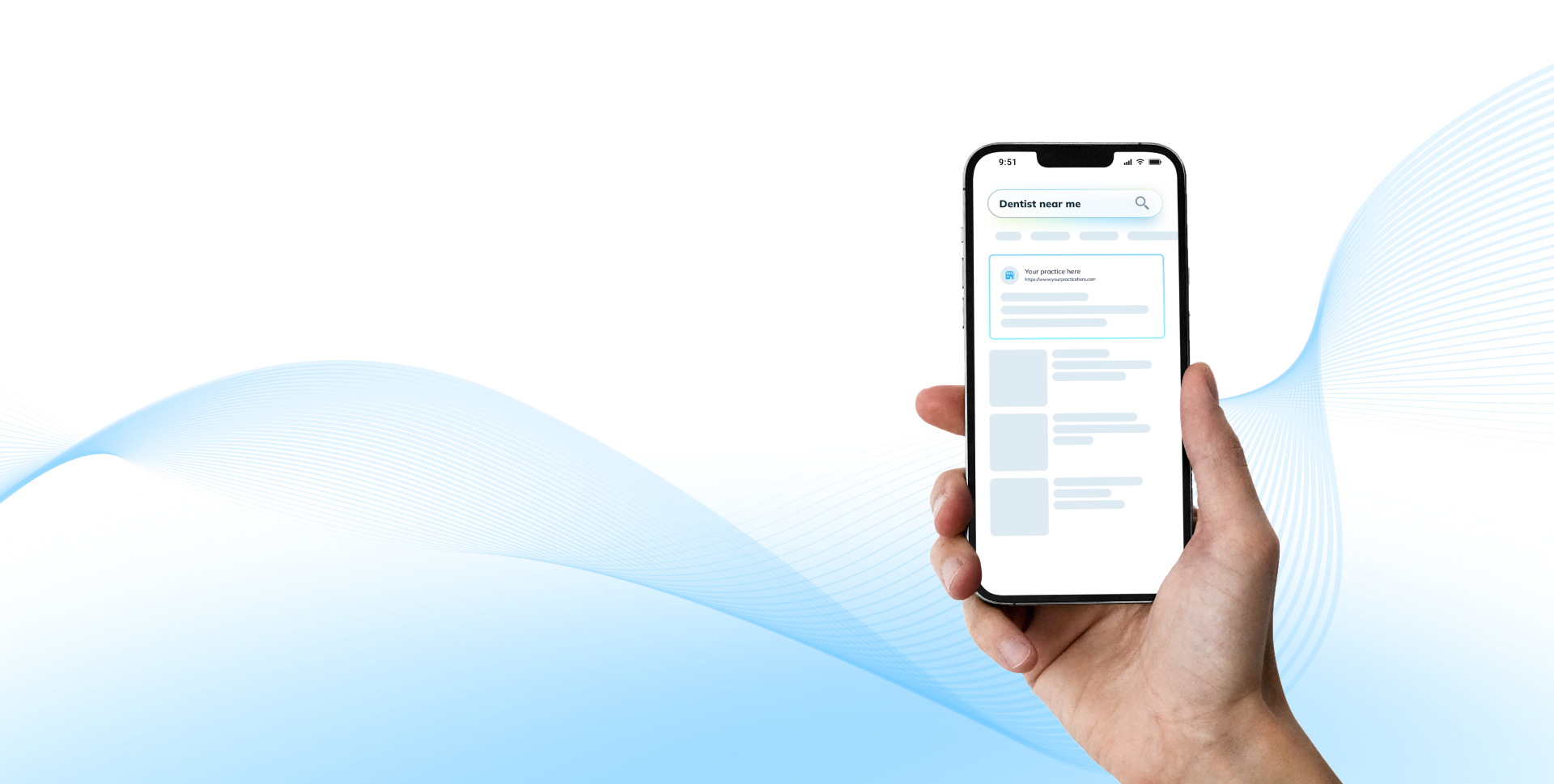
Patients increasingly open ChatGPT or Perplexity before they open Google. GEO, Generative Engine Optimization, is the discipline of making sure that when they do, your practice is the one that gets named, with the right details attached.
It is worth saying up front that this is a young field with a lot of noise in it. GEO was named in a 2023 academic paper and has since attracted an industry of vendors selling certainty that the research does not support. This guide takes a different approach: it explains what the published evidence actually shows, where that evidence is thin, and which parts of the work are worth doing anyway because they help you regardless of how these tools evolve.
The short version is that GEO is less mysterious than it sounds. Assistants reward pages that state facts plainly, back them with something quotable, and come from a practice whose information is corroborated elsewhere on the web. That is not a trick. It is just good publishing, held to a standard most dental websites never reach.
How GEO differs from classic SEO
SEO optimizes for a ranked list of links. GEO optimizes for a synthesized paragraph. The model is not choosing which page to send someone to; it is deciding which facts to state and which sources to trust enough to cite. That distinction changes what counts as success and, importantly, what counts as failure.
Recent research makes a useful further split that most vendors gloss over: there is a difference between being selected and being absorbed. Selection means an assistant retrieved and cited your page. Absorption means your page actually shaped what the answer says. One analysis of more than 21,000 citations across ChatGPT, Google, and Perplexity found these come apart sharply. Perplexity cited the most sources per prompt and Google cited broadly, while ChatGPT cited far fewer sources but drew much more heavily on each one it did use.
For a practice, this means a citation count is a weak scoreboard. Being one of sixteen links under a Perplexity answer is not the same as being the source ChatGPT paraphrased. The same study found the pages with real influence were longer, more modular, more closely aligned with the question, and denser in extractable evidence: definitions, numbers, comparisons, and step-by-step procedures.
What the research actually shows
The foundational study, from researchers at Princeton and IIT Delhi, built a benchmark of 10,000 queries and tested nine different ways of rewriting a page to see which earned more visibility in a generated answer. Three interventions stood out, each worth roughly 25 to 40 percent more visibility: adding citations to credible sources, adding direct quotations, and adding concrete statistics. The researchers also tested classic keyword stuffing. It was among the weakest strategies, which is a result worth sitting with if your current SEO habits lean that way.
Notice what those three winning interventions have in common. All of them give the model something specific and attributable to lift. A page that says 'we offer affordable implants' provides nothing quotable. A page that says implants in your area typically run a stated range, explains the three factors that move that number, and cites where the figure comes from provides three separate things an assistant can use. That is the entire mechanism, and it is the same reason those pages tend to convert human readers better too.
A second finding matters more for dentists than for almost anyone else. A large comparative study of AI search versus Google found that assistants show a systematic and overwhelming preference for earned media, third-party authoritative sources, over content a brand publishes about itself. A brand-visibility analysis of more than 100,000 AI responses put a hard number on it: only about 3 percent of citations pointed at the brand's own domain, while roughly three quarters pointed at other companies and third-party pages in the same space.
Read plainly, that is uncomfortable news for anyone who believes their website alone will carry them. Your own site is necessary, because it is what makes your facts available and consistent, but it is a minority of what the assistant reads. The directories, review platforms, and local publications that mention you are doing more of the work than your homepage is.
The same analysis found something that should temper expectations for smaller practices: brand stature dominates day-one visibility. Household-name brands appeared in about 73 percent of relevant unbranded answers, established regional brands in 44 percent, and small niche brands in just 11 percent. A single-location practice starts at the bottom of that ladder. The counterweight is that in local dentistry your competitive set is also small and mostly unoptimized, which is precisely why diligence still pays.
The platforms do not agree, and that is the opportunity
The most actionable finding in dental-specific research is how little the assistants overlap. A study of 750 queries across ten Florida metros and five platforms found that AI named a specific dental practice by name in 89 percent of cases, so these tools are genuinely recommending dentists rather than deflecting. But 94.7 percent of the practices recommended appeared on only one platform. Agreement between any two platforms ranged from roughly 5 percent to 56 percent; ChatGPT and Google AI Overviews agreed only about 19 percent of the time.
The reason is that each assistant leans on different underlying data. That means visibility is not one problem to solve but several, and the practices with the widest reach are the ones present and accurate across all the sources these tools draw from, not just the one they think of as their listing.
| Assistant | Leans on | What that means for your practice |
|---|---|---|
| ChatGPT | Bing index, Foursquare place data, health directories | Claim and verify Bing Places; do not ignore Foursquare and Apple Maps |
| Google AI Overviews / Gemini | Google's index, Knowledge Graph, Maps and Business Profile data | Profile completeness and on-site structure carry the most weight |
| Perplexity | Live search, review aggregators, Yelp and health directories | Review platforms and directory profiles do the heavy lifting |
| Claude | Live search of practice websites and review sites | Clear, well-structured service pages on your own site matter most |
Two practical notes on that table. It reflects observed behavior in published studies rather than any published commitment from these companies, so treat it as a guide to where to spend effort, not a fixed map. And the pattern it reveals is more durable than any individual row: the sources that get cited are the corroborated ones, so being consistently present across many of them beats being perfect on one.
A four-part GEO framework
Everything above reduces to four kinds of work. None require new technology, and all of them make your site better for human patients as a side effect, which is how you can tell they are worth doing.
- 1Structure. Schema for services, providers, hours, and reviews on every relevant page, with procedure-level markup on dedicated treatment pages. Structured data should describe what a visitor can actually see; markup that claims more than the page shows creates risk rather than advantage.
- 2Clarity. Write the way patients ask. Put the real question in the heading, answer it in the first two sentences, and only then add nuance. Use modular sections with descriptive subheadings so a retrieval system can lift the relevant chunk without dragging in the rest.
- 3Authority. Real provider bios with named credentials, school, years in practice, and specific procedures performed. Original detail counts most: your own fee ranges, your own recovery timelines, your own before-and-after documentation. This is the material that makes a page quotable instead of interchangeable.
- 4Consistency. Identical practice facts everywhere a crawler can find them, and presence on the third-party sources these tools actually cite: Google Business Profile, Bing Places, Apple Maps, Yelp, and the health directories relevant to your specialty. Given how strongly assistants favor earned media, this is usually the highest-leverage item on the list, and the one most practices neglect.
““The practice that answers the question in one clear sentence beats the practice that buries it under three paragraphs of marketing copy.””
Two specifics deserve calling out because they come up in nearly every audit. First, name your insurance carriers explicitly rather than saying 'most major insurance accepted,' since a large share of patient prompts are insurance-qualified and vague phrasing makes you ineligible for all of them. Second, put real numbers on your service pages. A stated fee range with an explanation of what moves it is more useful to a patient and more quotable to a machine than any amount of reassuring adjectives.
Measuring whether it is working
Ask the assistants directly. There is no dashboard for this yet, so a disciplined manual routine is genuinely the best available instrument, and it takes about twenty minutes a month.
- 1Build a fixed prompt set of ten to fifteen questions covering your top procedures, costs, insurance carriers, and an emergency scenario, phrased the way a patient would phrase them.
- 2Run the same set monthly across ChatGPT, Perplexity, Gemini, and Google AI Overviews, in a logged-out or private session so your own history does not skew results.
- 3Record three things for each: whether you were named, whether what was said about you is accurate, and which sources were cited instead of you.
- 4Run each prompt more than once. Published research finds substantial run-to-run variability, so a single result can be noise rather than signal.
- 5Treat the sources cited instead of you as your work list. If a directory keeps appearing and you have a weak profile there, that is a concrete, fixable gap.
One caution on interpretation. Research suggests whether a brand is mentioned at all is fairly stable, while whether it is described positively or negatively is far noisier, flipping several times more often than mention itself. Do not redesign your marketing because one answer was lukewarm about you. Do act if you are consistently absent, or if the facts stated about you are wrong.
Where the evidence is thin
This is the section most GEO content leaves out, and it is the one most likely to save you money. A 2026 critical survey reviewed 45 GEO studies and reached conclusions notably more cautious than the marketing around them.
- The famous 40 percent figure is real but narrow. It measures a relative visibility gain in a setting where the page was already retrieved and placed in the model's context. It does not demonstrate that these tactics get you retrieved in the first place, and it says nothing about durable traffic.
- Generic tactics transfer poorly. What worked in one benchmark, domain, or engine often does not carry to another, so playbooks sold as universal should be treated as hypotheses.
- Citation-focused rewrites can backfire. Aggressively rewriting pages to look quotable has been shown in some work to hurt retrieval, meaning you can optimize yourself out of consideration entirely.
- Competition erodes individual gains. When every practice in your market applies the same tactic, the advantage compresses. Early and specific beats late and generic.
- No technique has shown a stable, cross-platform, long-term causal effect on organic discoverability. The survey is explicit about this. Anyone guaranteeing you a placement is overstating what is known.
The reasonable response is not to disengage but to weight your effort toward things that are valuable independent of GEO. Accurate listings, honest pricing information, real provider credentials, genuine reviews, and pages that answer patient questions clearly all earn their keep whether or not an assistant ever cites them. Anything that only makes sense as an attempt to manipulate a model is a bet on a system nobody can see, and those bets tend to expire.
How DentalQore fits in
DentalQore has delivered dental marketing, done right, since 2008, across more than 5,000 practices. Most of what GEO asks for is work we were already doing, because it overlaps almost entirely with building a site that ranks and converts: structured data from day one, service pages written around real patient questions, consistent practice information across the web, and reputation management that keeps genuine reviews arriving. The AI shift did not change the work so much as raise the cost of skipping it.
Where a dental-focused partner helps most is in the unglamorous, high-leverage part: getting your practice accurate and present across the third-party sources these assistants actually cite, and keeping it that way as hours, providers, and services change. That is tedious, ongoing, and exactly the kind of thing that quietly decides whether you get named.
And to be plain about the boundary: we cannot guarantee that ChatGPT will recommend you, and we will not pretend otherwise. What we can do is make sure every fact these systems can find about your practice is correct, complete, and clearly stated, and help you read a monthly scoreboard that comes with no benchmarks attached. Reviews and day-to-day accuracy still depend on your team, because those are things only your team can generate.
Key takeaways
- GEO optimizes for being named inside a synthesized answer rather than ranked on a list, and being cited is not the same as being the source that shaped the answer.
- The best-supported tactics are adding concrete statistics, direct quotations, and credible citations, each worth roughly 25 to 40 percent more visibility in benchmark testing. Keyword stuffing was among the weakest strategies tested.
- Assistants heavily favor third-party earned media over your own site, with roughly 3 percent of citations pointing at a brand's own domain, so directory and review presence usually outweighs another homepage revision.
- The platforms barely agree. In dental-specific testing, 94.7 percent of recommended practices appeared on only one of five platforms, so breadth of accurate presence beats depth on any single one.
- Measure with a fixed monthly prompt set run across several assistants, repeat prompts to filter out noise, and fix inaccuracy before chasing absence.
- Be skeptical of certainty. A 2026 review of 45 studies found no technique with a proven stable, cross-platform effect on discoverability, so favor work that helps patients too.
Curious whether the assistants know your practice exists?
It takes one afternoon to find out, and most practices are surprised by what they learn, usually that a competitor is being named or that the details being repeated about them are years out of date. DentalQore offers a free website audit, competitor analysis, and custom growth strategy. Request a demo, or call 866-664-5216, and we will show you how your practice currently appears across AI-driven search and where the fixable gaps are.
Sources
- GEO: Generative Engine Optimization · Aggarwal et al., KDD 2024
- Optimizing Visibility in Generative Engines: A Critical Survey of Generative Engine Optimization (2023-2026) · arXiv
- Generative Engine Optimization: How to Dominate AI Search · arXiv
- From Citation Selection to Citation Absorption: A Measurement Framework for Generative Engine Optimization Across AI Search Platforms · arXiv
- Generative Engine Optimization at Scale: Measuring Brand Visibility Across AI Search Engines · arXiv
- Florida Dental AI Visibility Study · Local Vitals
Related service
AI Marketing
Rather have a team handle this for you? Our ai marketing service applies everything in this article, and it's measured against booked patients, not clicks.
Explore AI MarketingDentalQore Team
Dental Marketing Specialists
DentalQore has delivered dental marketing, done right, since 2008—18+ years and 5,000+ practices. Our writers, designers, and SEO strategists distill what's working across the network into plain-language guides.
18+ years of dental marketing expertise · Google Partner · Dental Marketing of the Year 2025